A trademark is often one of the most valuable assets a business owns — it is what customers recognize, trust, and return to.
What is a Trademark?
A trademark means a word, symbol, or picture, or a combination thereof, used by any firm, company, or individual on its products or services to distinguish them from the products or services of others. Once registered, a trademark grants its owner exclusive rights to use that mark in connection with the registered goods or services, along with legal recourse against unauthorized use or infringement by others.
What Is the Legal Basis for Trademark Registration in Nepal?
Trademark registration in Nepal is governed by the Patent, Design and Trademark Act, 2022 (1965) ("PDTA"), and is administered by the Department of Industry (DOI), Intellectual Property Section, under the Ministry of Industry, Commerce and Supplies.
What Are the Documents Required for Registering a Trademark in Nepal?
The following documents must be submitted along with the trademark registration application:
Document |
|---|
Certificate of Registration of Company or Firm |
Memorandum of Association (MOA) and Articles of Association (AOA), if the applicant is a company. |
Industrial Registration Certificate or relevant business license |
PAN or VAT Registration Certificate |
Tax Clearance Certificate (or extension approval document for tax clearance) |
Annual Compliance (Submission) letter |
Citizenship document of the concerned person(s) |
What Documents Must Be Drafted for Registering a Trademark in Nepal?
- Application to register trademark: Contains the name and address of the applicant, details of the potential trademark, and the class under which the potential trademark is to be registered, in accordance with the NICE Classification — an internationally standardized system of 45 classes covering goods and services. The application also specifies the goods or services in connection with which the trademark will be used. (The Department of Industry, IP Section, has a specific prescribed format for the trademark registration application.)
- Power of Attorney: Designates the person authorized to act on behalf of the applicant company throughout the registration process.
- Label of Trademark: 4 copies of the potential trademark (8 cm × 8 cm).
What Are the Government Charges for Trademark Registration in Nepal?
Charge | Amount |
|---|---|
Trademark registration application | Rs. 1,000 |
Trademark registration application amendment | Rs. 500 |
Trademark certificate (on approval) | Rs. 5,000 |
Trademark certificate renewal (within 35 days of expiry) | Rs. 500 |
Late renewal (within the 6-month grace period after expiry) | Rs. 500 + Rs.1000 |
What Is the Step-by-Step Process for Trademark Registration in Nepal?
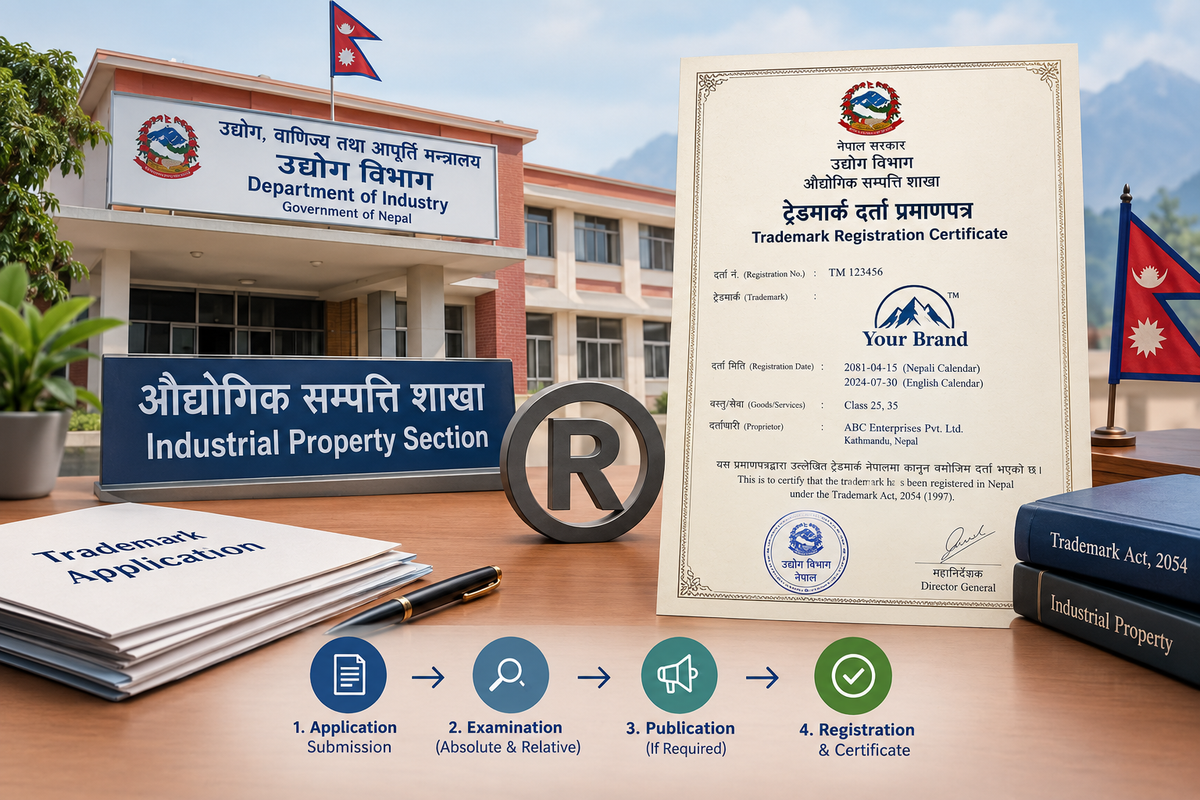
- Submission of application and preliminary examination: The application, along with all supporting documents, is submitted to the Department of Industry (IP Section). The Department then conducts a preliminary examination. At this stage, the application can be rejected if the potential trademark damages the reputation of a person or institution, is contrary to public morality or the national interest, damages the goodwill of an existing trademark, or is identical or similar to an already registered trademark.
- Publication in the IP Bulletin and opposition filing period: If the application qualifies, it is published in the IP Bulletin, inviting the general public and institutions to file an opposition if they have any objection. Any objection must be filed within 90 days of the publication of the IP Bulletin.
- Issuance of the Trademark Certificate: If no opposition is filed against the trademark after publication in the IP Bulletin, an application for issuance of the trademark registration certificate can be filed with the Department of Industry (IP Section), along with the registration fee of Rs. 5,000. The Department of Industry (IP Section) will then issue the trademark registration certificate.
How Long Is a Registered Trademark Valid in Nepal?
A registered trademark in Nepal is valid for 7 years from the date of registration. It can be renewed for an unlimited number of further 7-year terms. Renewal must generally be completed within 35 days of expiry; a 6-month grace period is available thereafter by paying an additional late fee, on top of the standard renewal charge.
Frequently Asked Questions (FAQs)
1. How long does trademark registration take in Nepal?
For a clean, unopposed application, the process can take roughly 4 to 6 months.
2. Can a foreign company register a trademark in Nepal?
Yes. Foreign individuals and companies can register trademarks in Nepal, generally by filing through a licensed Nepali trademark agent, and enjoy the same rights as domestic applicants once registered.
3. What happens if someone opposes my trademark application?
If an opposition is filed within the 90-day window after publication in the IP Bulletin, the Department of Industry reviews the objection, which can extend the registration timeline significantly — sometimes to 12 to 24 months or longer if the matter is appealed to the courts.
4. What happens if I don't renew my trademark on time?
If renewal is not completed within 35 days of expiry, a 6-month grace period is available by paying an additional late fee. If the trademark is not renewed even within that grace period, the registration — and the legal protection it provides — lapses.
5. What is the NICE Classification, and why does it matter?
The NICE Classification is an internationally standardized system that groups all goods and services into 45 classes. A trademark application must specify the class(es) under which protection is sought, since registration only protects the mark for the goods or services within the selected class(es).
6. Can my trademark application be rejected?
Yes. An application can be rejected during preliminary examination if the mark damages the reputation of a person or institution, is contrary to public morality or the national interest, damages the goodwill of an existing trademark, or is identical or similar to an already registered trademark.
7. Can a firm or company register a trademark without being registered as Industry?
No. Trademark is consider as the Industrial Property in Nepal thus, a firm or a company must be registered as a Industry before registering the Trademark by the concern firm or Company.
8. Can a Natural Person register a Trademark in Nepal?
No. A natural person need to first register an industry before registering any trademark.