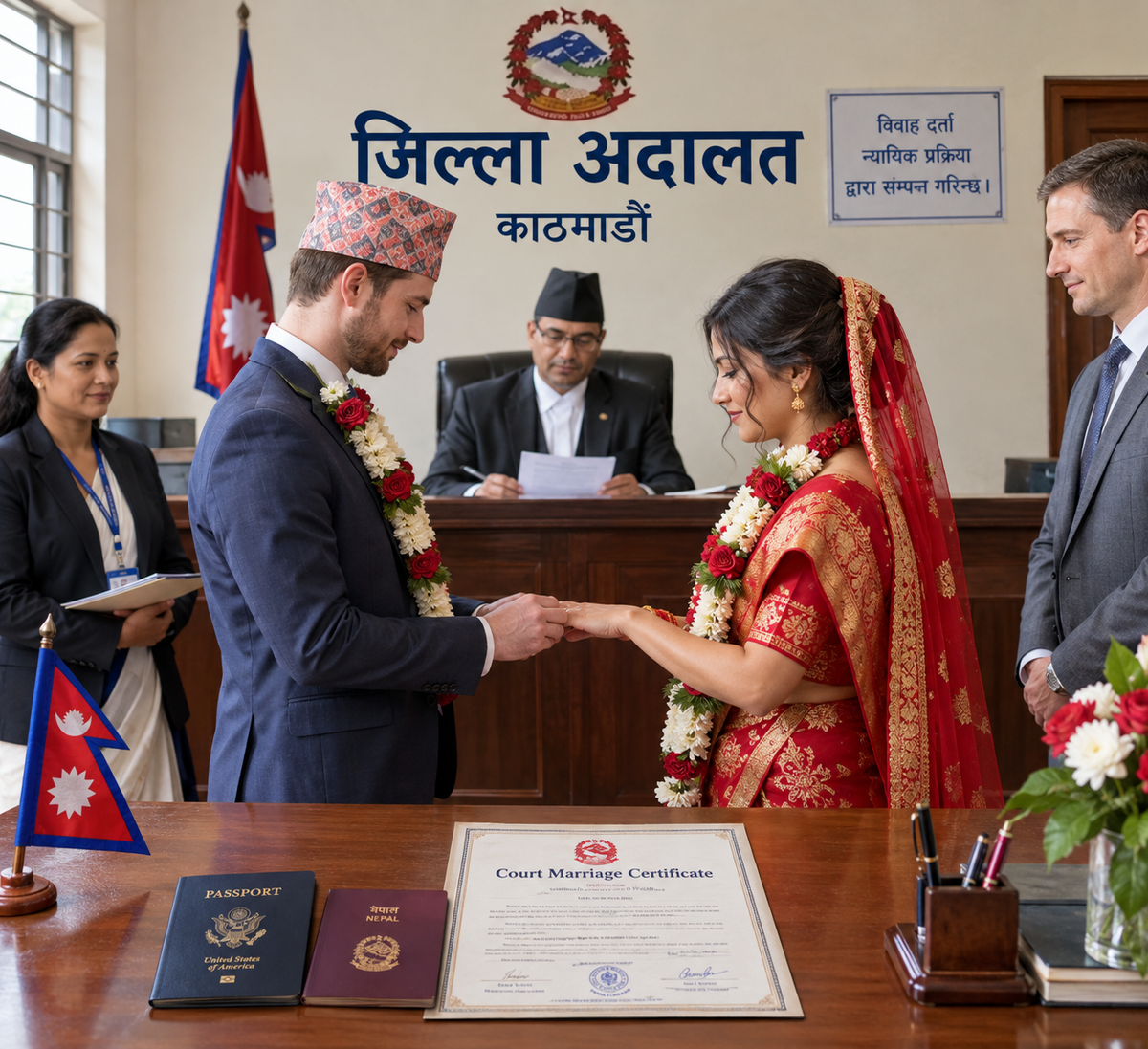
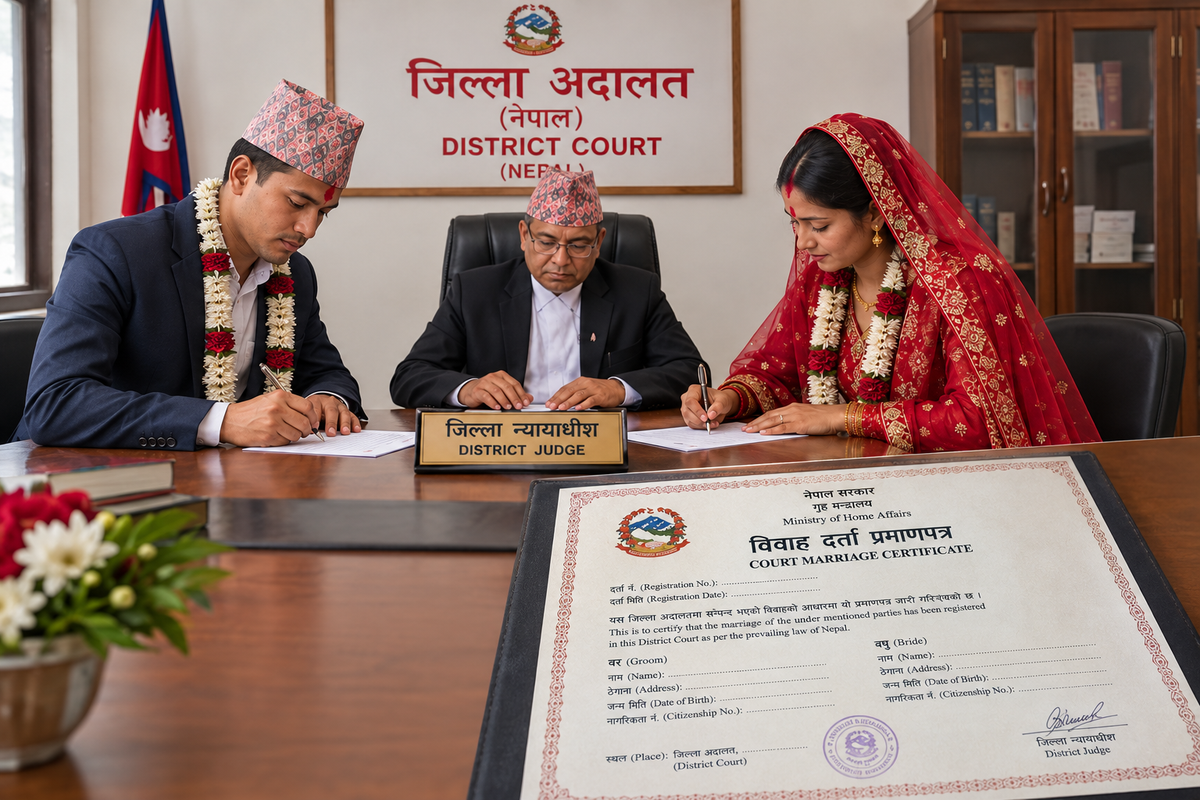
Court marriage is one of the fastest and most straightforward ways for a couple to legally marry in Nepal, without a traditional or religious ceremony.
What is Court Marriage?
Court marriage is the process of entering into a marital (conjugal) relationship by completing the legal procedure required by a court of law, rather than through a traditional or religious ceremony. It results in a legally binding civil union that is recognized both domestically and, after appropriate attestation, internationally.
What is the Legal Basis for Court Marriage in Nepal?
Court marriage in Nepal is governed by:
- Muluki Civil Code, 2074 - Sections 67 to 84 govern marriage while Section 77 to 80 specifically govern court marriage.
- Muluki CivilProcedure Regulation, 2075 - Rule 62
What are the Eligibility Criteria for Court Marriage in Nepal?
Under Section 70 of the Muluki Civil Code, 2074 defines the eligibility criteria for (court) marriage in Nepal:
- Both the bride and groom must be at least 20 years of age.
- Both parties must be unmarried or previously divorced or widowed (i.e., not currently married to someone else).
- Both parties must be free of any incestuous relationship.
- Both parties must give their free and mutual consent to the marriage.
Note: Bride and groom of certain caste-community are eligible for marriage within incestuous relationship, if their customs allow them to do so.
What Documents Are Required for Court Marriage in Nepal?
The following documents must be gathered before filing an application for court marriage:
Document | Required From | Requirement |
|---|---|---|
Citizenship or Passport | Bride and Groom | Mandatory |
Citizenship or Passport | 2 Witnesses | Mandatory |
Recommendation letter on marital status (unmarried/single/divorced) | Ward Office of permanent address | Mandatory |
Recommendation letter on temporary residency | Ward Office of temporary address | Only if court marriage is taking place in a district court outside permanent address |
Passport-size photographs (at least 4 copies) | Bride and Groom | Mandatory |
Migration Certificate | Bride and/or Groom | Only if permanent address has changed due to migration |
Divorce document | Bride and/or Groom | Only if previously divorced |
What Documents Must Be Drafted for Filing Court Marriage at the Court?
In addition to the supporting documents above, two documents must be specifically drafted and signed for filing at the concerned court:
Application for Court Marriage
This application contains the name, address, date of birth, occupation, and marital status of both parties, along with the names of their grandfather, grandmother, father, and mother, a self-declaration, the list of submitted documents, and witness details, among other particulars. It must be signed, along with a thumb impression, by both the potential bride and groom, and must also be signed by the witnesses.
Consent Paper
This document records the free and mutual consent of both parties to marry each other. It must be signed, along with a thumb impression, by both the potential bride and groom in the presence of the district judge and the witnesses, and must also carry the witnesses' signatures.
What Is the Step-by-Step Process for Court Marriage in Nepal?
- Gather all required documents — citizenship/passport, witness identification, ward recommendation letters, photographs, and (where applicable) migration or divorce documents.
- Draft the Application for Court Marriage and the Consent Paper, ensuring all required signatures and thumb impressions are included.
- File the application, along with all supporting documents, at the concerned District Court - either the court of the couple's permanent address, or another district court where temporary residency has been established.
- Pay the prescribed government fee of Rs. 500 at the time of submitting the application.
- Appear before the district judge, along with both witnesses, to sign the Consent Paper and confirm free and mutual consent.
- Receive the Court Marriage Certificate issued by the concerned District Court upon successful verification.
What Is the Fee for Court Marriage and Certificate in Nepal?
A government fee of Rs. 500 must be paid while submitting the application for court marriage at the concerned District Court. Once the process is complete, the concerned District Court issues the court marriage certificate to the married couple at no additional charge.
Frequently Asked Questions (FAQs)
1. How long does the court marriage process take in Nepal?
For Nepali citizens with all documents in order, court marriage can typically be completed within 1 to 2 working days of filing the application at the District Court.
2. Is Court Marriage Required to Be Registered at the Local Level (Ward)?
Yes. Marriage registration at the local level is a separate matter and should not be confused with court marriage. A couple can obtain a marriage registration certificate by registering their marriage - whether solemnized as a court marriage or a customary marriage - at the local level, i.e., the ward office.
3. Can court marriage be done without parental consent?
Yes. Court marriage in Nepal can be completed without parental consent, as long as both parties are at least 20 years old and voluntarily consent to the marriage. Parents are not required to be present.
4. Can a foreigner get married through court marriage in Nepal?
Yes. Nepal allows citizens of any other country for court marriage. However, a foreign national is typically required to complete a minimum residency period, obtain a temporary residence recommendation from the local ward office, and may need a No Objection Certificate from their embassy in Nepal.
5. Is court marriage legally valid without a wedding ceremony?
Yes. A court marriage is a fully legal civil union recognized under the Muluki Civil Code, 2074, regardless of whether a traditional or religious wedding ceremony has taken place.
6. What happens if a party is under 20 years of age?
A marriage where either party has not completed 20 years of age is void under Nepali law, and those involved in arranging or facilitating such marriage may face criminal penalties, including imprisonment and fines.
7. Which District Court should the application be filed in?
The application is generally filed at the District Court having jurisdiction over the couple's permanent address, or, where applicable, over a temporary residence they have established and had recommended by the local ward office.
8. Is court marriage the same as marriage registration at the ward office?
No. Court marriage is the judicial process of marrying before a District Court, while marriage registration at the ward office is a separate local registration process - a couple who marries through a court, or through a customary ceremony, must still register the marriage at the ward office to obtain a marriage registration certificate.