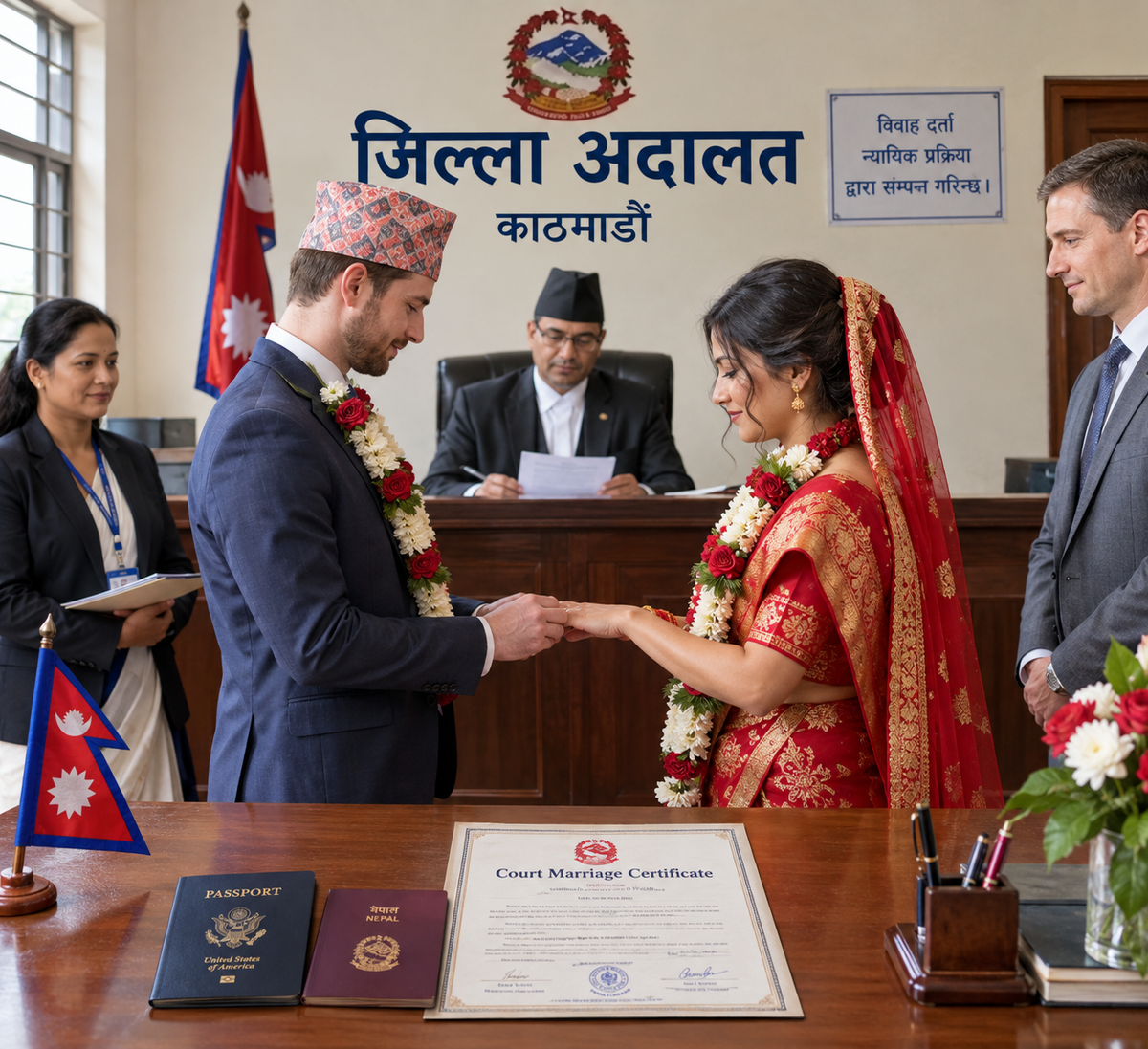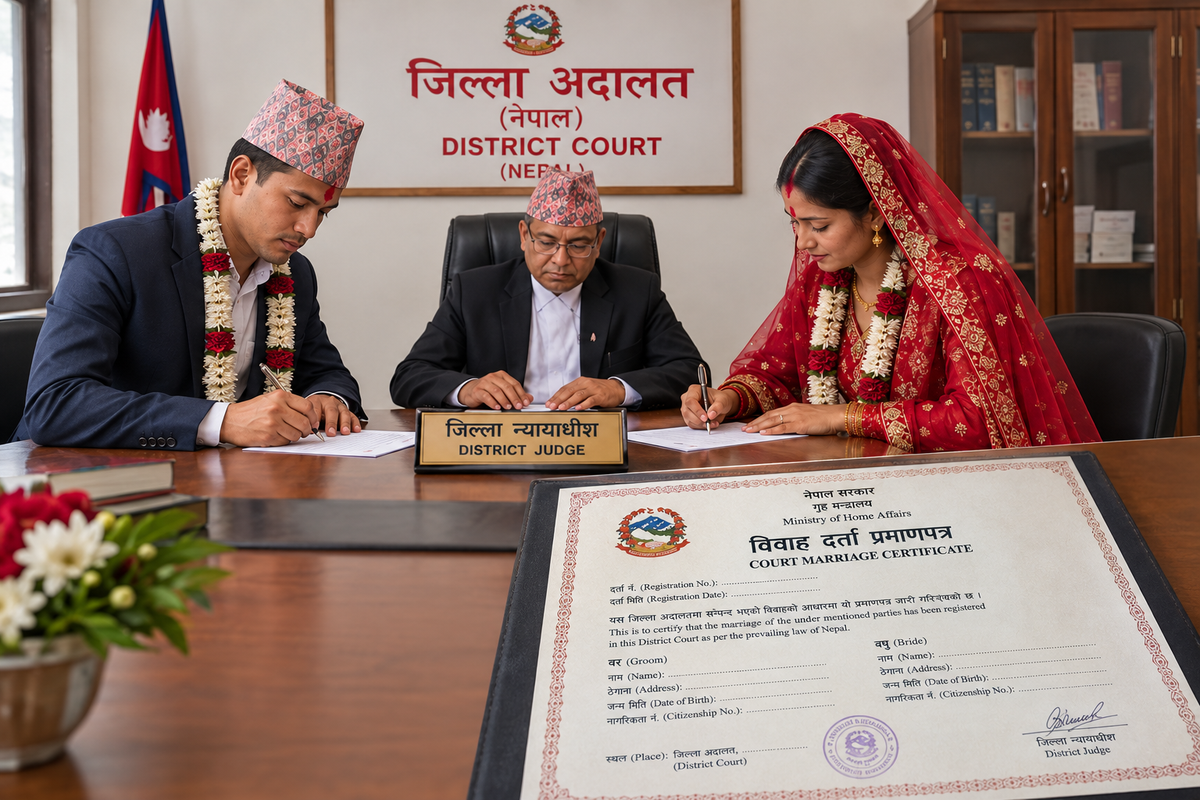
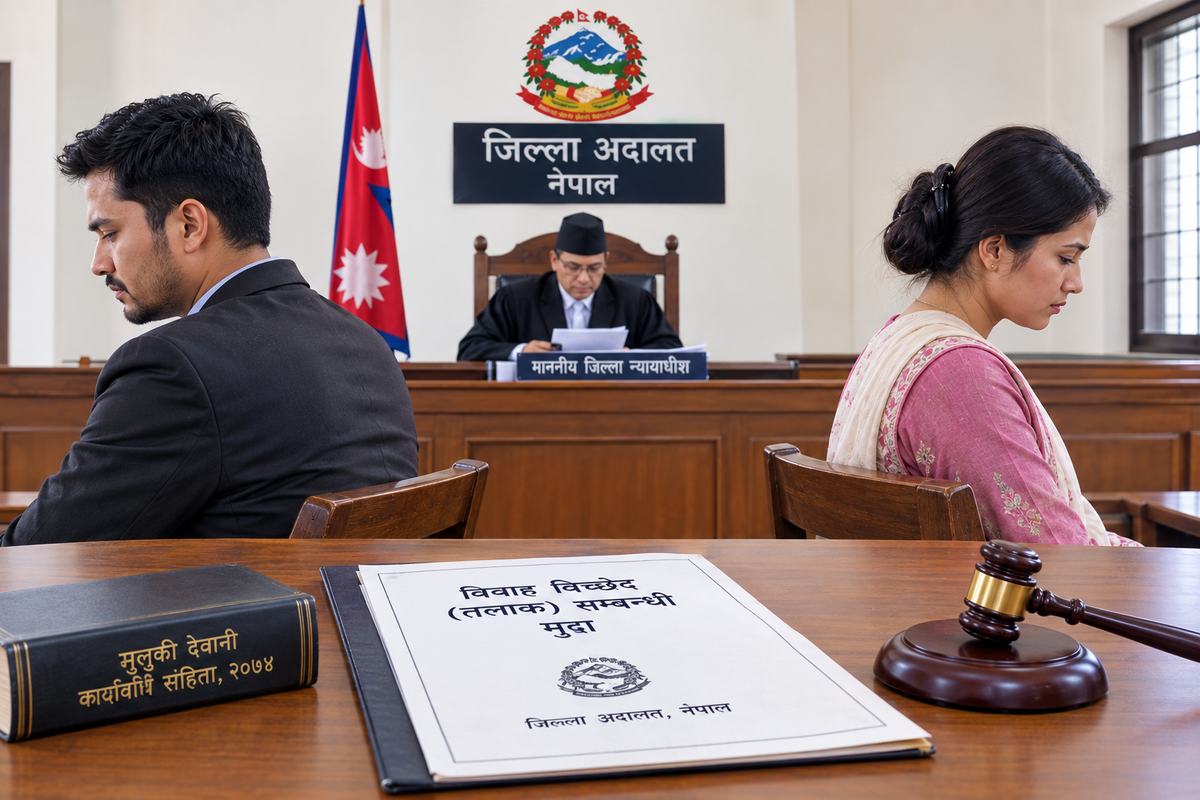
Divorce in Nepal is a court process, and the grounds on which it can be sought differ depending on whether both spouses agree to end the marriage or only one of them wants to.
What Is Divorce?
Divorce is a court process for terminating a valid marriage between a couple. A valid marriage is a precondition for the divorce process - a marriage that does not qualify as valid must instead be declared void or voidable through a separate court process if it falls under either category.
What Is the Legal Basis for Divorce in Nepal?
Divorce in Nepal is governed by:
- Muluki Civil Code, 2074: Sections 93 to 104, governs divorce, including mutual consent divorce, fault-based grounds for the husband and wife, property partition, and alimony.
Under this framework, a divorce may be obtained either by mutual consent of both spouses (Section 93), or by either spouse filing without the other's consent, provided the fault-based grounds set out in Section 94 (for the husband) or Section 95 (for the wife) are met.
What Are the Grounds for Filing Divorce by the Husband in Nepal?
As per Section 94 of the Muluki Civil Code, 2074, a husband may file for divorce without his wife's consent on any of the following grounds:
- If the wife has been living separately, continuously for 3 years or more, without the consent of the husband.
- If the wife deprives the husband of maintenance costs or abandons him from the house.
- If the wife commits, or conspires to commit, an act likely to cause grievous hurt or severe physical or mental pain to the husband.
- If the wife is proven to have had sexual relations with another man.
What Are the Grounds for Filing Divorce by the Wife in Nepal?
As per Section 95 of the Muluki Civil Code, 2074, a wife may file for divorce without her husband's consent on any of the following grounds:
- If the husband has been living separately, continuously for 3 years or more, without the consent of the wife.
- If the husband deprives the wife of maintenance costs or abandons her from the house.
- If the husband commits, or conspires to commit, an act likely to cause grievous hurt or severe physical or mental pain to the wife.
- If the husband concludes another marriage.
- If the husband is proven to have had sexual relations with another woman.
- If the husband is convicted of marital rape.
Note: The wife has two additional grounds not available to the husband — bigamy (the husband entering into another marriage) and marital rape — reflecting Nepal's criminalization of both under the Civil Code, 2074 and the corresponding Criminal Code, 2074.
Can a Couple Get Divorced by Mutual Consent in Nepal?
Yes. Under Section 93 of the Muluki Civil Code, 2074, if both the husband-and-wife consent to the divorce, they can obtain it at any time, without needing to prove any fault-based ground and without a waiting period.
How Is Contested Divorce Different from Mutual Consent Divorce?
A mutual consent divorce, since it requires no proof of fault, is generally the faster route and can often be finalized within a few working days once the court is satisfied that the consent is genuine and voluntary. A contested divorce, on the other hand, requires the filing spouse to prove one of the specific grounds under Section 94 or Section 95, and typically takes considerably longer due to evidence and witness examination.
Frequently Asked Questions (FAQs)
1. What is the difference between the husband's and wife's grounds for divorce?
The husband has four grounds under Section 94, while the wife has six grounds under Section 95. The two additional grounds available only to the wife are bigamy (the husband marrying another person while still married to her) and marital rape.
2. Can either spouse claim alimony after divorce?
No. Under Section 100 of the Muluki Civil Code, 2074, it is explicitly mentioned that only the wife may claim alimony based on the wife had not taken the partition property.
3. Is property divided during a contested divorce?
Yes. Partition on divorce is governed by Section 99 of the Muluki Civil Code, 2074. When the divorce is granted due to the husband's fault, the wife can generally demand her share of property before the divorce is finalized.
4. How long does a contested divorce take in Nepal?
A contested divorce requires proving one of the grounds under Section 94 or Section 95 in court, a process that can take 6 months or more, compared to a mutual consent divorce, which can often be completed within a few working days.
5. Is marital rape recognized as a ground for divorce in Nepal?
Yes. Under Section 95 of the Muluki Civil Code, 2074, a wife can file for divorce if the husband is convicted of marital rape - a ground available only to the wife, not the husband.
6. What happens to a marriage that isn't valid in the first place?
A marriage that does not meet the legal conditions for a valid marriage is not addressed through the divorce process. Instead, it must be separately declared void or voidable by the court, depending on which category it falls under.