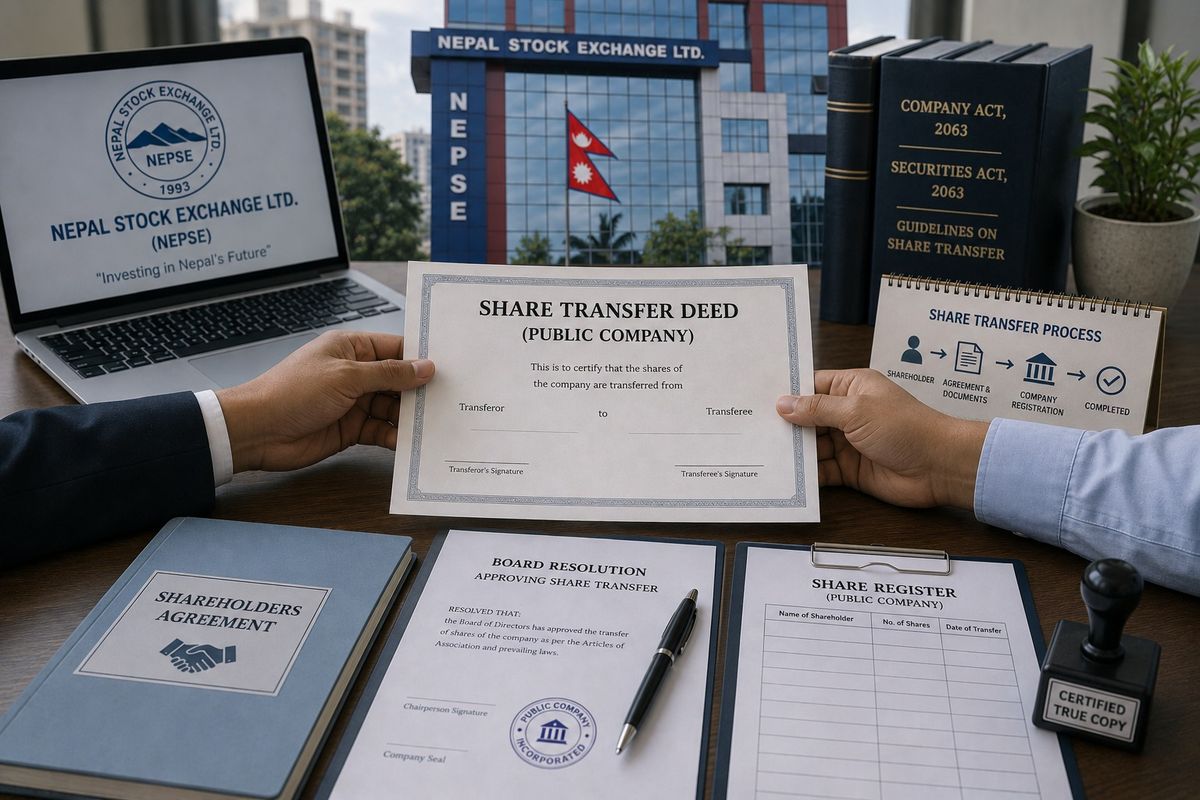
Not every public company in Nepal is listed on the Nepal Stock Exchange (NEPSE). Many public companies remain unlisted while their shares still change hands. For these companies, NEPSE's Over the Counter (OTC) Market provides the only legal, regulated channel through which shareholders can buy and sell shares.
This article explains what the OTC market is, the documents required for a company and its shareholders, the fees involved, and the step-by-step transaction process.
What Is the Over the Counter (OTC) Market?
The Over the Counter (OTC) market is a platform where securities i.e. shares, bonds, debentures, and similar instruments of non-listed public companies are traded. In Nepal, NEPSE itself operates the OTC market, as per the OTC Market Operation Bylaws,2065, where the shares of public companies that have not yet completed the listing process or that have been delisted are traded.
What are the Documents Required for a Non-Listed Public Company to Register in the OTC Market?
Before any share of a non-listed public company can be traded, the company itself must first be registered in NEPSE's OTC market. The following documents are required:
- Application for registration
- A form stating the company's details (name, address, objectives, capital structure, etc.)
- Registration Certificate of the company
- Memorandum of Association (MOA) and Articles of Association (AOA) of the company
- Shareholder Book (Share Lagat) of the company
- Directors' Book (Sanchalak Lagat) of the company
- Permanent Account Number (PAN) Registration Certificate
- Board of Directors' decision to register the company in the OTC market
- Board of Directors' decision to trade the company's shares through the OTC market
- Audit report of the last fiscal year
- Sample of the share certificate
- Any other document required by the OTC Market Officer
What are the Documents Required for Trading Shares in the OTC Market?
Once a company is registered, its shares can be traded. A share transaction requires documentation from three sides i.e. the company, the buyer, and the seller.
From the company
- Application for share transaction on the company's letterhead (naming the buyer, seller, number of shares, and share price)
- Registration Certificate of the company
- Memorandum of Association (MOA) and Articles of Association (AOA) of the company
- Board of Directors' decision to trade the company's shares through the OTC market
- Shareholder Book (Share Lagat)
- Audit report of the last fiscal year
- Per-share net worth of the share
From the buyer (purchaser)
- Share Purchase Order
- Copy of citizenship
- Copy of PAN certificate
- Copy of tax clearance certificate
- KYC (Know Your Customer) form
- Source of investment declaration
- Application for registration of share (Dakhil Kharej)
From the seller
- Share Sell Order
- Copy of citizenship
- Copy of PAN certificate
- Copy of tax clearance certificate
- KYC form
- Deed of sale of share
- Payment voucher of profit tax
If the buyer or seller is a company (not an individual)
- Company Registration Certificate
- PAN Certificate
- Tax Clearance Certificate
- Board of Directors' meeting minutes
Additional requirements
- Bank statement verifying the share transaction payment
- A letter from the Credit Information Bureau (CIB) confirming that the buyer, seller, and company are not blacklisted
- Payment voucher of SEBON and NEPSE fee.
- Capital Gain Tax Payment Voucher, if applicable.
What are the Applicable Charges for OTC Share Transactions?
The following charges apply based on the transaction amount:
Transaction Amount (NPR) | SEBON Fee | NEPSE Fee | Profit Tax |
|---|---|---|---|
Up to Rs. 25,000 | 0.015% | 0.20% | 10% (resident individual) 15% (resident entity) 25% (others) |
Rs. 25,001 – Rs. 50,000 | 0.015% | 0.18% | 10% (resident individual) 15% (resident entity) 25% (others) |
Rs. 50,001 and above | 0.015% | 0.15% | 10% (resident individual) 15% (resident entity) 25% (others) |
How Share Transactions of Non-Listed Public Companies Work: Step-by-Step Process
- Company registration: The non-listed public company must first register with NEPSE's OTC market, submitting all the registration documents listed above.
- Application by buyer and seller: The share buyer and seller submit an application seeking approval to buy and sell the company's shares.
- Board approval: The company's Board of Directors approves the application and decides to route the transaction through the OTC market.
- Document submission: All required documents - from the company, buyer, and seller - are submitted to the OTC market along with the company's transaction application.
- Payment of charges: The applicable SEBON fee, NEPSE fee, and profit tax are paid, and the payment voucher is submitted.
- OTC verification: NEPSE's OTC desk verifies the transaction and issues a confirmation letter to the concerned company.
- Transfer documentation: The seller submits the deed of share transfer, and the buyer submits the application for transfer and registration of shares (Dakhil Kharej / Namsari).
- Board decision on transfer: The company's Board of Directors approves the share transfer and registration, along with verification of the updated Shareholder Book (Share Lagat) from the Office of the Company Registrar.
- Filing with the Company Registrar: The company submits all relevant documents, along with NEPSE's OTC transaction letter, to the Office of the Company Registrar (OCR).
- Final verification: The Office of the Company Registrar verifies the updated Shareholder Book, completing the ownership transfer.
Frequently Asked Questions (FAQs)
1. Can any public company's shares be traded on the OTC market?
Only non-listed public companies that have completed OTC registration with NEPSE — submitting their MOA/AOA, registration certificate, share ledger, and board decisions — can have their shares traded on the OTC market.
2. Is a Credit Information Bureau (CIB) clearance really required for a share transaction?
Yes. A letter from the CIB confirming that the buyer, seller, and the company itself are not blacklisted is a mandatory document for the transaction to proceed.
3. Who decides the share price in an OTC transaction?
Unlike NEPSE's main board, OTC transactions do not use automated order-matching. The price is typically negotiated between the buyer and seller, supported by the company's per-share net worth as a reference point, and disclosed in the application submitted to NEPSE.
4. What tax applies to profit from an OTC share sale?
Profit tax (capital gains tax) applies at 10% for resident individuals, 15% for resident entities, and 25% for other categories, calculated on the profit earned from the sale — subject to the applicable transaction-amount slab.
5. What happens after the OTC transaction is approved?
The company still needs to complete share transfer and registration (Dakhil Kharej/Namsari) with its Board of Directors and get the updated shareholder ledger verified by the Office of the Company Registrar before the transfer is legally complete.
6. Is the OTC market the same as NEPSE's regular secondary market?
No. NEPSE's main board handles electronic trading of listed securities, while the OTC market is a separate, manually verified platform specifically for non-listed or delisted public company securities.
OTC market rules, required documents, and fee structures are set by NEPSE and SEBON and may be revised periodically. Readers should verify current requirements with NEPSE's OTC desk or a licensed merchant banker before initiating a transaction.